Your career change plan Run your career change like a well-managed project.
You want a next move that fits who you are, and a clear way to get there. The Blueprint programme gives you twelve linked modules, one repeating cycle and a plan you can follow.
The challenge
Most career changes stall between the idea and the first step.
Out there
Advice is everywhere, but rarely joined up into a plan you can follow week by week.
In here
"Who am I now, and what do I actually want?" is hard to answer alone.
What's right
A change this important deserves the same structure and care as any major project.
Your guide: the programme was built from years of running recruitment, learning and organisational change, then applying the same discipline to individual careers.
Section 1 · Philosophy
You are the project manager of your own career.
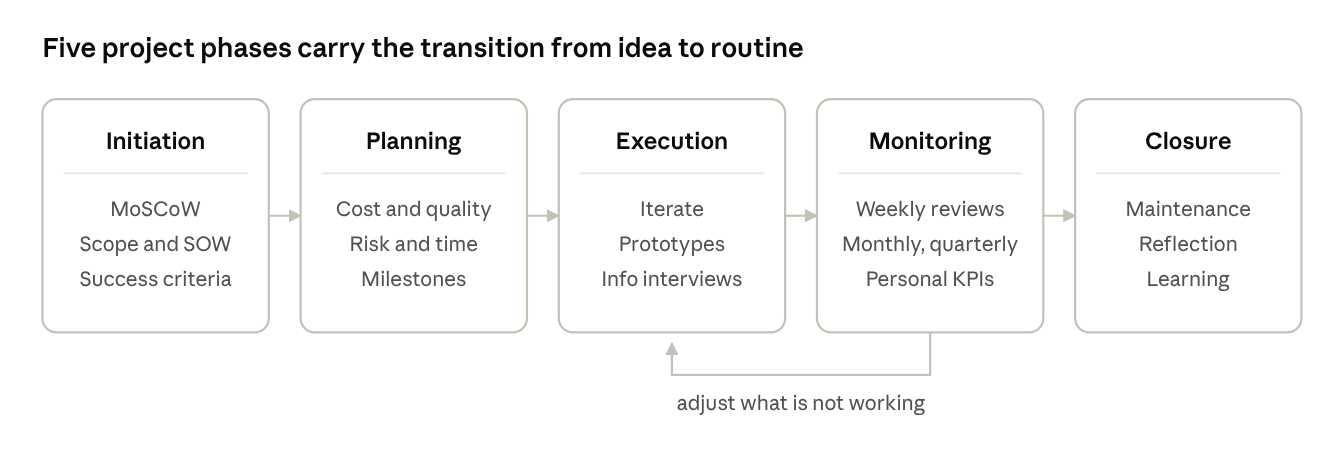
A career move works best when planned and actioned, so you evolve and your identity matches. Project methods give you scope, plans and reviews; change methods help with the doubt and loss that come with any transition. Learning to run your career this way is also a skill employers value.
Key takeaways
- Treat your next move as a project with a goal, a plan and regular reviews.
- Test ideas with small experiments before making big commitments.
- Expect emotional ups and downs; they are part of change, not a sign of failure.
The transition project plan
Section 2 · The journey
Twelve modules, one repeating cycle.
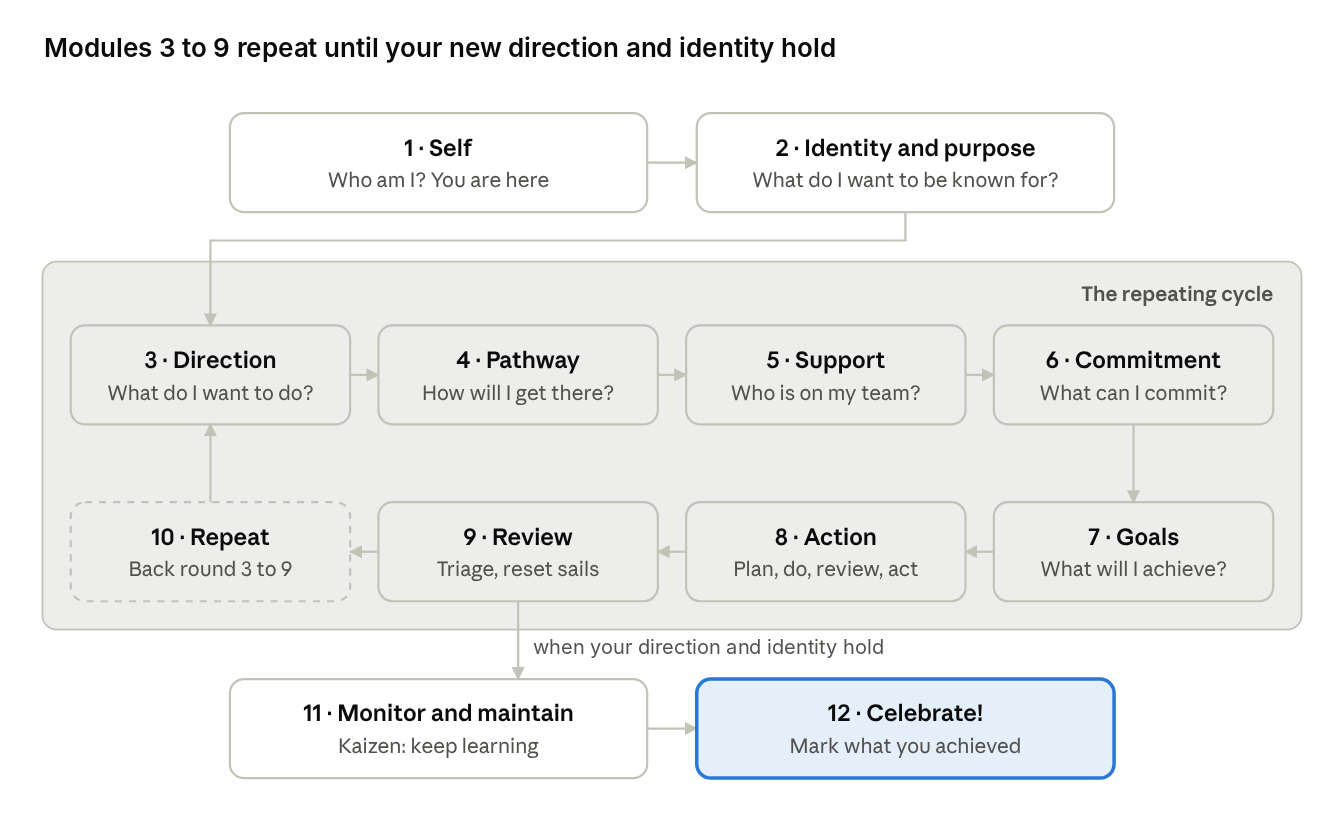
You lay the foundation once, then work through Modules 3 to 9 as often as you need. Each loop sharpens your direction, tests it in the real world and turns it into goals and weekly action. When your new direction and identity hold, you move to maintenance and celebration.
Key takeaways
- Start with who you are, not with job adverts.
- Going round the loop again is progress, not failure.
- Celebrate on purpose: recognising effort builds the confidence for the next move.
Section 3 · The cycle
Discover, decide, act, review. Then go again.
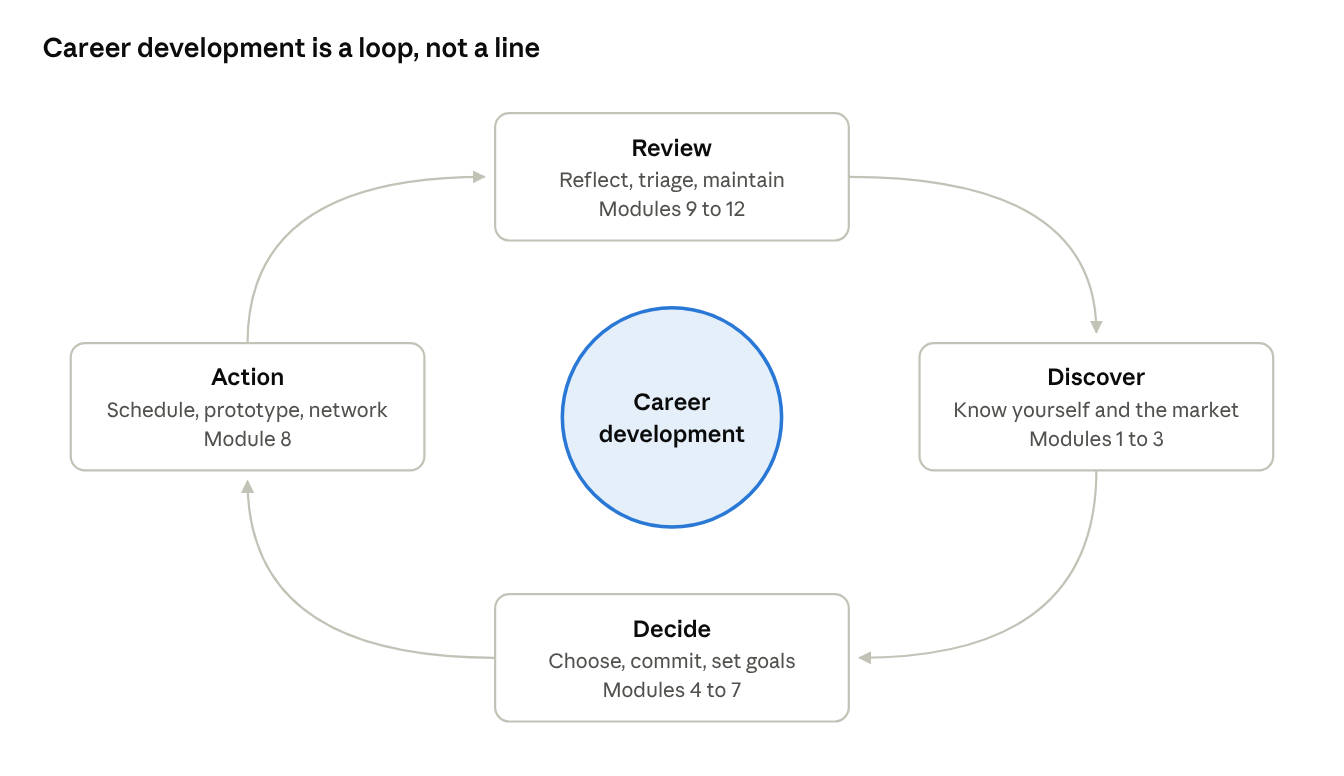
This is the simple model you take away for life. Every future transition, whether a promotion, a redundancy or a planned change, runs through the same four stages. Supporting tools include values, attributes and career-driver card sorts, and a map of the people who influence your career.
Key takeaways
- Career development is a loop, not a ladder.
- Most stuck people are trying to decide before they have discovered enough.
- Build a review into your year so the next change starts on your terms.
Section 4 · Setting career goals
Find where four questions overlap.
List ten things under each question, circle the items that appear in more than one, and shape three options as close to the centre as you can. Then test each one with a conversation, a short course or a side project before setting goals.
Key takeaways
- Few people start in the centre: it is built over time, not found.
- A missing circle shows you what to work on next, not a reason to give up.
- Meaning can come from parts of a job, or from life outside work.
Sources: García and Miralles (2016), Ikigai; Winn (2014); O'Keefe, Dweck and Walton (2018), Psychological Science.
Section 5 · Old career, new career
Not one ladder, but several careers in a lifetime.
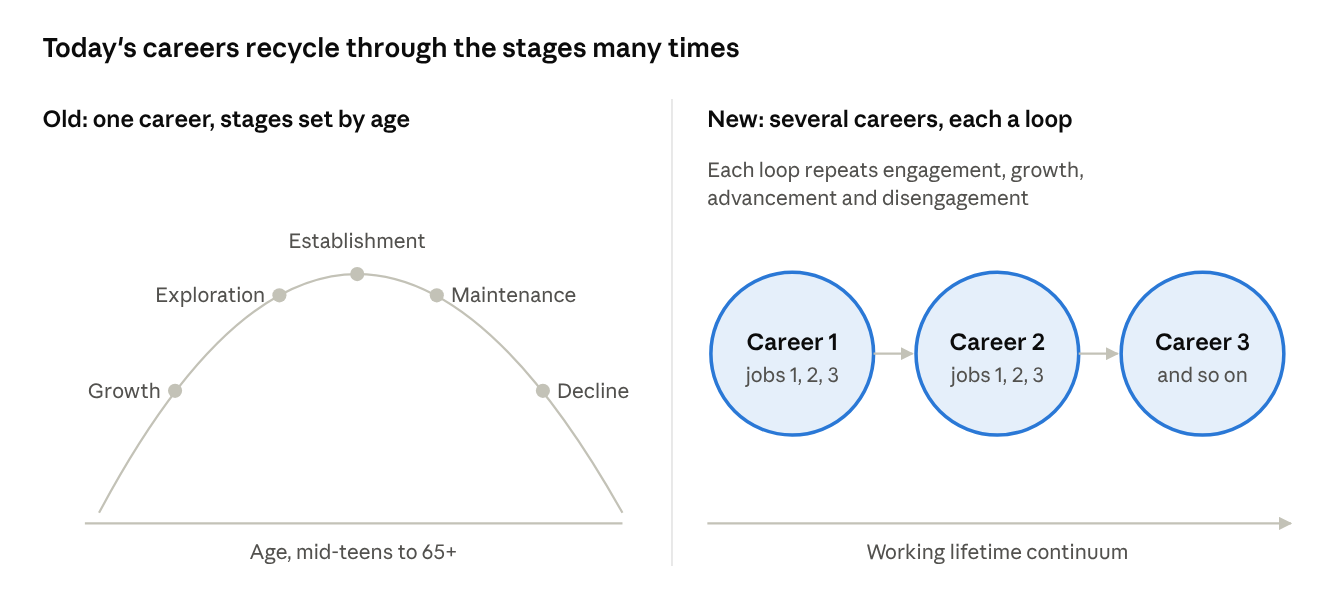
Donald Super's classic model linked career stages to age, though he noted people "recycle" through them at transitions. Today recycling is the main story: most people will move through several careers, each with several jobs. The skill that matters most is the ability to change well, again and again.
Key takeaways
- Expect to reinvent more than once in your working life.
- Every skill you learn in this programme will be used again.
- Age is not a stage limit: you can start a new loop at 25 or 60.
Source: Super (1980), Journal of Vocational Behavior.
Section 6 · The case for being proactive
Choose your next move before events choose it for you.
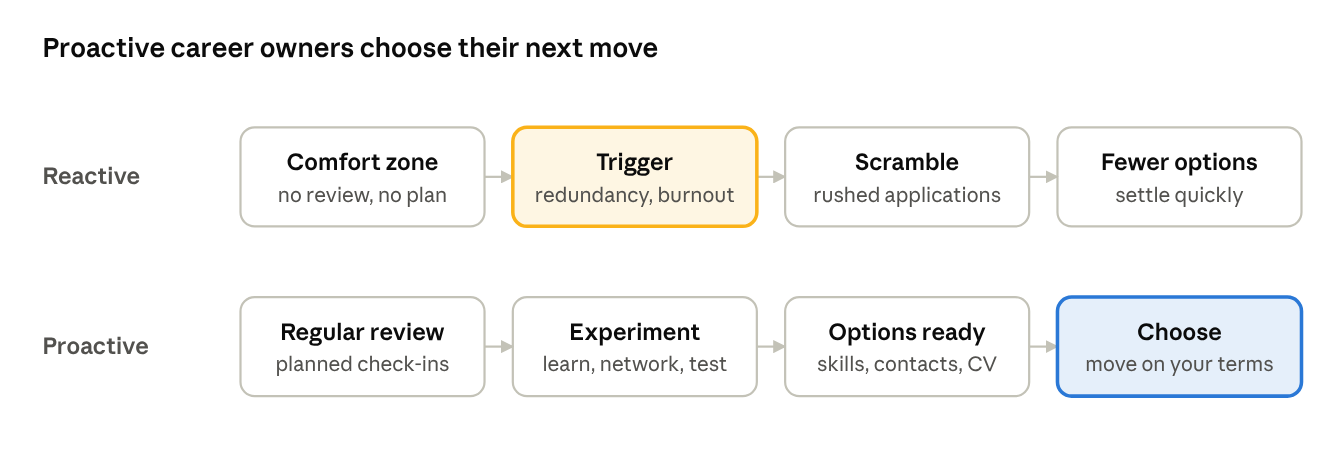
Employers expect 39% of workers' core skills to change by 2030. A review of 107 studies found that proactive people achieve more career success in pay, promotion and satisfaction, and the behaviours behind it can be learned. Proactivity widens your options; it does not remove real barriers such as discrimination or caring responsibilities.
Key takeaways
- Hold an annual career review, even when things are going well.
- Keep your network warm when you don't need anything.
- Update your achievements and skills every quarter.
Sources: World Economic Forum (2025), Future of Jobs Report; Fuller and Marler (2009), Journal of Vocational Behavior; Seibert, Kraimer and Crant (2001).
Section 7 · How it runs
Group energy, one-to-one depth, support in between.
The programme blends group sessions for learning and accountability with one-to-one coaching for the personal work. A workbook keeps your charter, plan and reflections in one place, and a peer group keeps momentum going between sessions. Choose the length that fits your situation.
Key takeaways
- Group sessions give you peers who know what you are going through.
- One-to-one coaching goes deeper on what is specific to you.
- Pick the length that matches the size of the change, not the shortest option.
Fees: [YOUR PRICE] per tier, flat fee.
What's at stake
A year from now, where would you rather be?
Still thinking about it
Same role, same doubts, and a growing sense that time is passing.
Living the plan
A tested direction, a support team, and weekly progress you can see.
Start your blueprint.
Book a free 30-minute exploratory call, or begin with the free Career Transition Project Plan.