The future of work Work is changing. Your career can change with it.
You want to stay relevant and choose work that fits your life. Here is what is really changing, what it means for you, and the skills that travel from one career to the next.
The challenge
The old career deal has ended, quietly for some, abruptly for others.
Out there
AI, longer lives and new ways of working are reshaping jobs faster than job titles change.
In here
Headlines about robots and redundancies make it hard to know what to believe or do.
What's right
You deserve facts, not fear, and a plan that works whatever the future brings.
Your guide: every figure on this page comes from a named source, and we flag where forecasts are uncertain.
Section 1 · The big picture
Four forces are making careers self-managed and multi-stage.
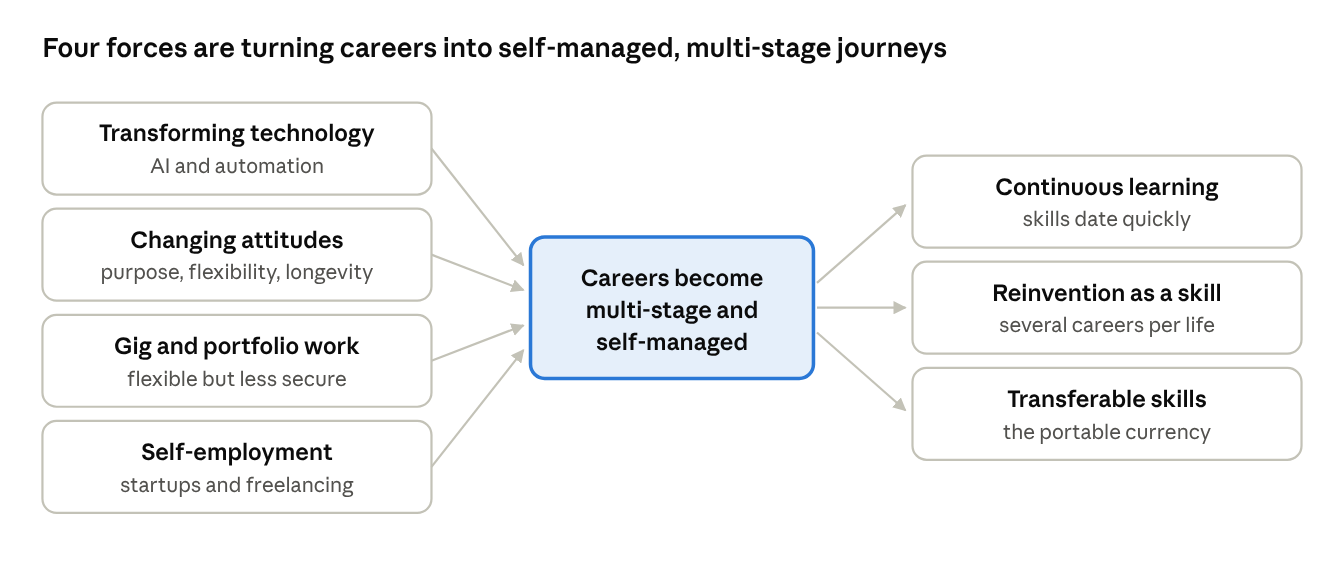
The old deal swapped loyalty for security and promotion. The new one puts you in charge: your value rests on your skills, reputation and network rather than on one employer. That brings more choice, and more risk, which is not shared equally.
Key takeaways
- Expect several careers, each with several jobs.
- Own your learning: don't wait for an employer to plan it.
- Think beyond full-time jobs: bridges and blends are real options.
Section 2 · Transforming technology
AI is changing tasks faster than it is removing jobs.
The World Economic Forum expects 170 million new roles and 92 million displaced by 2030, a net gain. PwC found jobs growing even in AI-exposed occupations, with people who use AI well paid more. The useful question is not "will my job exist?" but "which of my tasks will change, and what will I do instead?"
Key takeaways
- Learning to use AI tools is now a transferable skill in every sector.
- Judgement, relationships and creativity are what AI complements, not replaces.
- Forecasts are direction of travel, not prediction: revisit them yearly.
Sources: World Economic Forum (2025), Future of Jobs Report; PwC (2025), Global AI Jobs Barometer.
Section 3 · Changing attitudes and needs
Money, meaning and wellbeing, not just a job title.
People increasingly judge work by whether it is meaningful, flexible and sustainable. Longer lives also break the old pattern of education, then work, then retirement: expect more stages, including time to retrain and explore. Flexibility is valued, but access to it is uneven.
Key takeaways
- Define your own success criteria beyond pay and title.
- Flexibility is something to negotiate for, and a valid reason to move.
- Differences within a generation are larger than between generations.
Sources: ONS (2025), hybrid working; Deloitte (2025), Gen Z and Millennial Survey, UK results; Gratton and Scott (2016); Costanza et al. (2012).
Section 4 · Gig and portfolio work
Every work option trades security for autonomy.
More security and structure
More autonomy, risk and upside
Gig work as a main job is about 1.4% of UK employment, but around one in ten adults did some platform work weekly by 2019. For most it tops up income. A portfolio career, holding several streams at once, can be a deliberate bridge: keep part of the old career while building the new one.
Key takeaways
- Use gig and freelance work to test a new field with real clients.
- Check your employment status: it decides your rights to sick pay and holiday.
- Many career changers combine two options at once.
Sources: CIPD (2023); TUC (2019); IOSH (2025); Uber BV v Aslam [2021] UKSC 5; Handy (1989).
Section 5 · Startups and self-employment
Test demand before you leap.
UK businesses, latest ONS figures
More than four million people in the UK are self-employed, and around 317,000 new businesses started in 2024. Fewer than four in ten reach five years, so the safest route is to start from who you are, what you know and whom you know, risk only what you can afford to lose, and test with paying customers early.
Key takeaways
- Has someone paid, or committed to pay, for what you offer? Then you may have a business.
- Agree a financial runway and a "decide by" date before you start.
- Freelancing in your current field is the lowest-risk first step.
Sources: ONS (2025), Business demography, UK: 2024; ONS Labour Force Survey; Sarasvathy (2001); Ries (2011).
Section 6 · The art of reinvention
Act your way into a new identity.
Test-and-learn loop · repeat
Research on people who changed careers found they rarely worked out the answer first. They tried things, met new people and let their story evolve. Most reinventions recombine existing strengths rather than throwing the past away.
Key takeaways
- Don't wait for certainty before taking a first step.
- Seek out people already doing the work; old networks can hold you to your old identity.
- Present your past as the foundation for your new direction.
Sources: Ibarra (2003), Working Identity; Markus and Nurius (1986); Savickas (2013).
Section 7 · Transferable skills
Your portable currency, if you translate it.
Employers' top core skills for 2025 were analytical thinking, then resilience, flexibility and agility, then leadership and social influence. But skills don't transfer by themselves: you have to translate your achievements into the language of your target role and show the evidence.
Key takeaways
- Collect five adverts for your target role and mirror their language.
- Turn each achievement into a short Situation, Task, Action, Result story.
- Close real gaps with a course or a prototype, not by overstating.
Sources: World Economic Forum (2025); Barnett and Ceci (2002), Psychological Bulletin.
Section 8 · IQ, EQ and SQ
Thinking, feeling and connecting.
Evidence: strong
Evidence: moderate
Evidence: moderate
General mental ability is one of the best single predictors of job performance. Emotional intelligence helps most in emotionally demanding work and can be trained. Social intelligence, measured at work as "political skill", predicts reputation and career success and grows with practice and feedback.
Key takeaways
- Experience keeps adding knowledge and judgement well into later life.
- EQ and SQ are skills to build, not fixed traits.
- Be wary of free online tests: use validated tools, for development only.
Sources: Sackett et al. (2022); Joseph and Newman (2010); Mattingly and Kraiger (2019); Ferris et al. (2005); Munyon et al. (2015).
What's at stake
Left behind by change, or ready for it?
Waiting it out
Skills date, options narrow, inflexibility causes stagnation and change arrives on someone else's timetable.
Ready for what's next
Current skills, a clear story, flexing to your circumstance with the confidence to reinvent when you choose.
Where do you stand?
Take the free ten-minute Health Check, or talk it through on a free 30-minute exploratory call.