Change management tools Tools that make change stick.
You want to make real progress, not just plans. These are the project, change and coaching frameworks we use to keep you moving, translated into career language.
The challenge
Plans fail when they ignore the core of the person carrying them out.
Out there
Job searches drift: endless research, scattered applications, no follow-up.
In here
Motivation rises and falls. Rejection hits confidence just when you need it most.
What's right
You deserve methods with evidence behind them, not willpower alone.
Your guide: a review of 47 job search programmes found participants were 2.67 times more likely to find work when programmes combined job search skills with motivation. Every tool below does one or both.
Source: Liu, Huang and Wang (2014), Psychological Bulletin.
Section 1 · The process
Five phases, three decision gates.
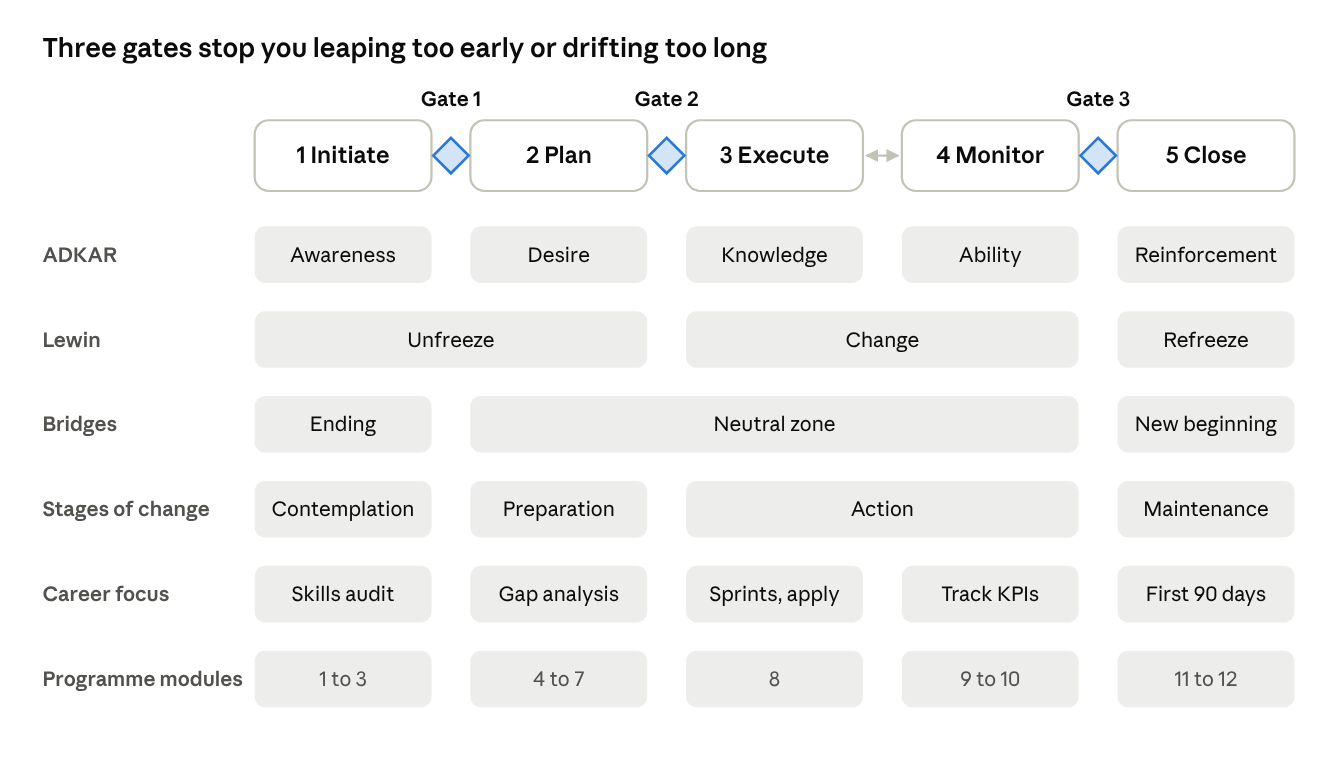
Each phase covers four things: skills, behaviours, job search and the emotional side of change. The gates stop the two most common failures: leaping into applications before you know your direction, and researching forever without acting.
Key takeaways
- Write a one-page career charter before you apply for anything.
- Work in two-week sprints with a clear goal for each.
- Plan your first 90 days in the new role before you start it.
Sources: PMI (2021), PMBOK Guide; Cooper (1990), Stage-Gate; Watkins (2013), The First 90 Days.
Section 2 · The human side
Know what you are likely to feel at each stage.
| Model | Initiate | Plan | Execute | Monitor | Close |
|---|---|---|---|---|---|
| ADKAR | Awareness | Desire | Knowledge | Ability | Reinforcement |
| Lewin | Unfreeze | Change | Refreeze | ||
| Bridges | Ending | Neutral zone | New beginning | ||
| Stages of change | Contemplation | Preparation | Action | Maintenance | |
Change models explain why people stall. Bridges shows that the uncomfortable "in-between" is normal and creative. ADKAR helps you spot the first weak link: no amount of interview practice helps if the real gap is wanting to leave. The Stages of Change remind us that slipping back is a step in the process, not failure.
Key takeaways
- Feeling lost in the middle is a stage, not a verdict.
- When stuck, find the first weak step: awareness, desire, knowledge, ability or reinforcement.
- Organisational models such as Lewin and Kotter are useful checklists, not proven science.
Sources: Bridges (1991); Hiatt (2006); Prochaska and DiClemente (1983); Cummings, Bridgman and Brown (2016).
Section 3 · The skill/will matrix
Rate the task, not the person.
List your key tasks, rate your skill and your will for each from 1 to 5, and plot them. The same person can need four different kinds of support in one week: confident at research, reluctant at networking. Re-rate at every sprint review; tasks should drift towards Delegate.
Key takeaways
- Low will needs work on "why", not more training.
- Low skill needs practice and feedback, not a pep talk.
- Match helpers to need: a mentor for Guide tasks, an accountability partner for Excite tasks.
Adapted from Hersey and Blanchard's Situational Leadership, which has mixed research support: use it as a practical guide.
Section 4 · Motivation
Build motivation into the plan, so willpower isn't doing all the work.
It is hard to think about purpose when the rent is worrying you, so start with the basics. Then find what genuinely drives you and the one or two things you would never trade away. Finally, design motivation into the plan: picture the obstacle as well as the goal, and decide in advance what you will do when it appears.
Key takeaways
- Motivation often follows action: small completed steps build confidence.
- Visualise the obstacles, not just the outcome.
- "If X happens, I will do Y" plans make goals far more likely to happen.
Sources: Deci and Ryan (2000); Schein (1990); Oettingen (2014); Gollwitzer and Sheeran (2006).
Section 5 · Solution-focused coaching
Build on what already works.
Instead of asking "what's wrong, and why?", solution-focused coaching asks "what would better look like, and when has it already happened?" When you are stuck, map your thoughts, feelings, behaviour and situation, then start where change is easiest: usually what you do or who you are around, rather than a deep belief.
Key takeaways
- Ask "on a scale of 0 to 10, where am I, and what would one point higher look like?"
- Look for exceptions: times the problem was smaller or absent.
- One small, successful change ripples into the other three areas.
Sources: Grant (2003); Grant and O'Connor (2010); Grant (2012). Studies are small and short-term, but consistent.
Section 6 · Your job search board
Move every opportunity left to right.
Borrowed from agile project teams, a simple board makes your whole pipeline visible. Review it at every sprint. Track what you do (conversations, applications) and what comes back (replies, interviews, offers): the stage where things stop tells you exactly what to fix.
Key takeaways
- Few replies? Fix your targeting or CV. Interviews but no offers? Practise interviewing.
- Following up beats sending more applications.
- Paper, Trello or the workbook all work; reviewing it is what matters.
Sources: Schwaber and Sutherland (2020), The Scrum Guide; van Hooft et al. (2013).
Section 7 · Design thinking
Test a direction cheaply before you commit.
People rarely think their way into a new career; they discover it by trying things. Sketch three different five-year futures, then test each with a conversation, a short course, shadowing or a small paid project. Keep what energises you and drop what doesn't, before you have spent much time or money.
Key takeaways
- Plan three possible futures, not one perfect answer.
- A 20-minute conversation with someone in the role is the cheapest prototype there is.
- Treat a failed test as useful data, not a setback.
Sources: Burnett and Evans (2016), Designing Your Life; Ibarra (2003), Working Identity.
What's at stake
Busy, or making progress?
Without the tools
Lots of activity, little traction, and confidence that drains with each unanswered application/email, silence.
With the tools
Clear phases, honest reviews, and support matched to exactly where you are stuck. Get set up for success.
Put these tools to work on your move.
Book a free 30-minute exploratory call, or download the Career Transition Project Plan.